In life, so many people do their best to put us down and keep us down. It can be for our race, our beliefs or just because they are not so pleasant people. It can be quite dispiriting. What can you do in those situations?
One solution that works in every case is to work on being the healthiest version of ourself. This is multifaceted and gives us plenty to work on while we deal with our challenges. Our health consists of physical, mental and spiritual or emotional health. When we have these in order, we are poised for success. The more we work on them, the better our potential.
There are so many ways to work on our health. It can be our diet and eating better. It can be engaging in physical fitness. It can be meditation to heal from trauma. It can be learning to change our mindset to better reflect the life we wish to live.
Do not let the world get you down. When it is doing its best to try, work hard on yourself and your health. That is both your physical, mental and emotional or spiritual health. You will come out stronger no matter what challenge you are facing.
This may seem a little contrary, but stick with us. There are so many people that spend their entire life in the planning phase that life passes them by. When they are ready to put their plans in action they are too old or life has provided a reason not to do it. It could be a health challenge or a situational change.
Life should be a balance of planning and action. Do not let life pass you by while you are planning to start it.
Monday can be tough for all of us. It can start Sunday night. A tightening on the stomach knowing the work week is one alarm clock away. It is important to remember that picturing the best can help eliminate a lot of that anxiety.
It doesn’t have to be limited to Monday or work for that matter. In any situation, imagine the best case scenario. It did not cost anything and can reduce stress and increase joy.
Most of you reading this will be tempted to say, “I would not like suffering at all.” That would be an ideal life. It is also quite unrealistic. In everyone’s life, there is suffering. We do not get to choose when, or what kind we get.
What we do have a choice of is what we do with that suffering. We can grow from suffering. Like the mythical phoenix rising from the ashes. The other option is to let it destroy us. Shatter our hopes and dreams.
Suffering gives us few options. The one that we do have is a powerful one. That is what we decide the meaning of that suffering will be.
Take a look around you. Wherever you happen to be reading this. It could be while getting your morning coffee. It could be in break at work or right before you go to bed. Feel free to share when you usually read this website.
Even if you happen to be reading this while waiting for the dentist, this holds true. If you look around there will be something you are grateful for. It could be that morning coffee you are making. It could be the coworker you get along with. If it is at night, your soft pillow is something worth gratitude. Even at the dentist, you could be grateful for the exit door!
I would recommend doing this several times a day. It not only increases gratitude, but gives a feeling of peace and tranquility in a often hectic world. I would love to hear both what time of day you read this site as well as what you are grateful for around you right now!
Last post we discussed how small actions and habits can have disastrous results. That was a little negative. Although still very true. Today, we are going to look at the opposite. We are going to look at good habits and how, given time, they can transform our life positively.
To do this, let us look at a metaphor that might help put it in perspective. I do not play golf. I’m not sure if you do or not. We can all appreciate the basics. You got a ball and try to get it into a hole several hundred yards away.
At the point of contact, a slight change in the direction you hit the ball, even millimeters, can have a huge impact as to where the ball lands. Think of it. If you change the angle 2 millimeters and follow the ball several hundred yards, it will be in a dramatically different spot.
That’s often how positive actions and habits work in our life. We take one small action. Perhaps it is cutting out drinking our daily Coca-Cola. Nothing much happens right away. We follow that change for several months, or a year, and we discover our pants fit better and we have less inflammation.
Think of these examples when you make a small change. You might have to stick with it a while. After which, it may lead to a huge impact. Just like the millimeter and the golf ball.
Where I live, right now is tick season. To be honest, every season it seems we are told is tick season. Ticks are nasty relatives of the aracnid (spider) family. They live on tall grass and hop on your body when you brush against them. The worst thing is what their bite can do. Ticks carry diseases such as rocky mountain fever and Lyme disease. These can, on occasion, even be fatal.
As my mother and I hiked through the park this afternoon, we pondered just such a thing. My mother remarked, “Isn’t it crazy how something so small can cause such damage?” It immediately started me thinking how true this is of many things in life.
Bad habits may seem small and insignificant, but can really add up. Say you throw a piece of trash on the ground. One wrapper, not such a big deal? If everyone in the world thought the same way, that would be roughly 8 billion pieces of trash! Just from one small wrapper.
The same holds true with people. Some people, dare I say, share many qualities with the tick. Their ‘bite’ may seem harmless at first, but it can have impacts that could end up fatal to your goals and even you! How about the person always telling you that it is OK not to eat healthy or worry about your fitness. At first, it may even seem nice. You end up with lower standards and a stomach as big as your pile of excuses!
When it comes to friends who drink too much, or even drink and drive, it can be far more serious. Small things can have such an impact on our life that we must remain diligent in staying alert to them. Next post we will take a look at another example, but in the positive. Until then, watch your habits and watch out for ticks!
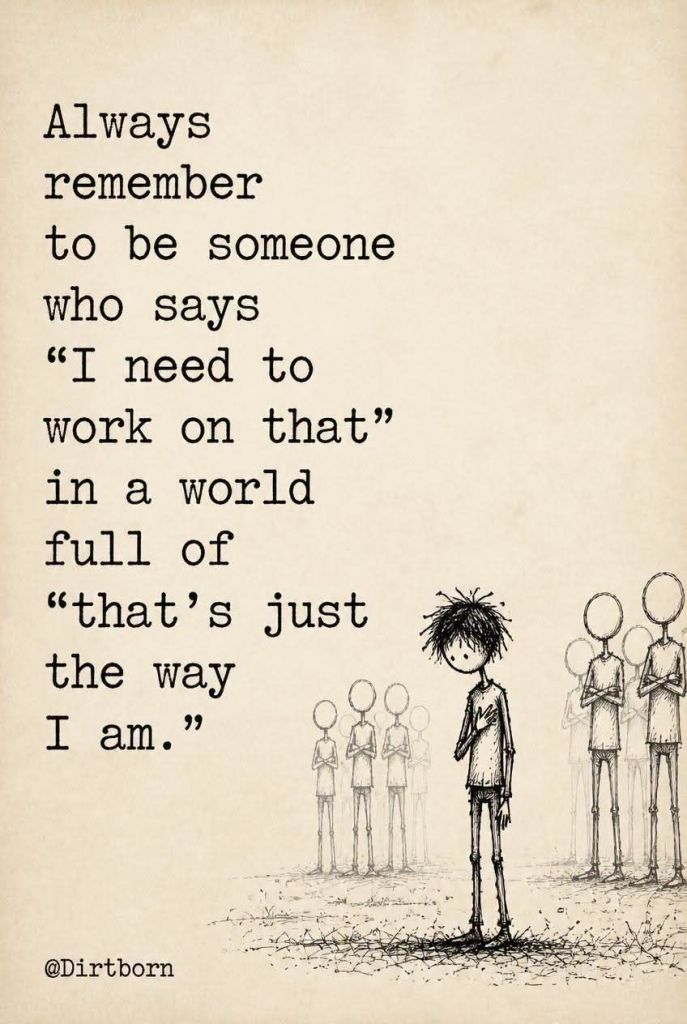
One of the things that drives me crazy is people who explain away bad habits, a negative attitude or abusive behavior with the phrase, “That is just the way I am.” In a world where you can change literally anything about yourself, it is no longer ‘just who you are’. No, the correct phrase would be, “That is who I am choosing to be.”. When you do your best to excuse away your character flaws it says two things. One, you do not have the self-awareness or self-discipline to work on improving yourself. Two, you choose to let your emotions control you instead of controlling them.
Saying “That’s just the way I am.” makes you look lazy and disrespectful. This is not saying that you need to change yourself to please someone else. No. Having quirks and creative differences make us the beautiful unique creatures we are. When you find yourself making that statement after describing a negative behavior, no that it is a choice. “He wants me to control my temper, but that is just the way I am.” Really translates to those of us hearing it to “I have an anger management problem that I am too self-centered to work on.” If you enjoy having a bad temper, that is on you. To pretend that is something that is ‘just you’ and that you cannot change is not true.
Conversely, when you hear someone say “I am working on that.” They not only sound instantly more respectful, but also more self-aware and self-disciplined. None of us are perfect. There are all things we need to work on. If you find yourself adding the phrase “That is just who I am.” after a negative behavior, you should realize that you are making an excuse. There are no areas in our life that we cannot work to improve. Be the type of person who says, “I am working on that.” Even more to the point, be the type of person who does. You will not only receive more respect from others, but you will come to respect yourself more.
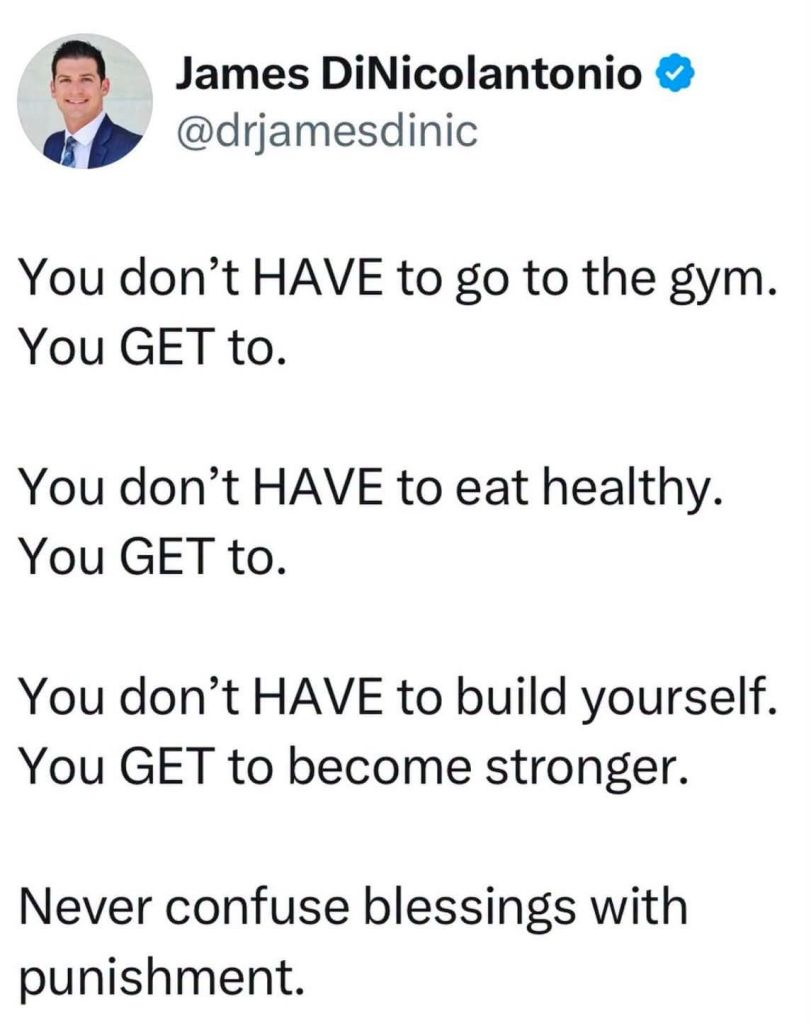
To many of you this may sound cliche or, at the very least, like some positive thinking nonsense. I do suppose it could be a little of both. That does not make it any less true. Much like anything in life, familiarity breeds contempt. Almost nobody I know enjoys going to work. If they lost their job, however, they would be happy to have an opportunity to earn money. Once back at a job, how long before they start to grumble about ‘having to get up early’? I am guilty of this myself.
My lovely lady is one of the most vocal critics of going to the gym. I think she spends so much time dreading it she might burn more calories doing that than working out. She did put this whole thing in great perspective the other day. After some introspection and contemplation, she looked at me and said, “I hate going to the gym, but I love how I feel when I leave.” Meaning going through all the sweating, moving your body when you do not want to and sore muscles are not enjoyable. Leaving knowing that you put in the effort and are one step closer to a healthier you is a great feeling. Wisely, she focuses on the future to be able to propel her to take productive action. It is a way to trick overcome her brain’s desire for inaction.
Speaking of working out. Recently, I sustained an injury that will prevent me from doing some things that I both enjoy and need to do. Now that I cannot do them, guess who is motivated to do them? Of course after the surgery I am going to be so motivated to go back to doing these exercises, right? That may be true in the short term, but after a few days of soreness from starting over, I will probably go back to dreading them. How do we change this to a constant state of motivation to do the things we know we need to do?
Many people ask how to stay motivated to take the actions they need to. I have written several books on the subject myself. It is the wrong question to be asking. Yes, it is good to have more motivation. Yes, it is good to find new and different ways to be motivated. Even with all of that, we will never be motivated all of the time. Not to mention, for most of us, motivation is a depreciating asset. As discussed in the earlier examples, you can be motivated at the start, but as time goes on that motivation becomes more difficult to maintain. What we need is a change in perception.
Inky Johnson, one of my favorite speakers, says that perception drives performance every day of the week. He emphasizes how important why we do what we do is. I couldn’t agree more. If you are working just for yourself, that is one kind of motivation. If you have a spouse and family depending on you, that is an entirely different kind of motivation. There is a difference between someone who works hard and a hard worker. Someone who works hard will do so if the boss is watching or the pay is right. Someone who is a hard worker will work hard because that is their character. That is the promise they made to themselves. How about you? What is your perception on doing the difficult things in life?
Becoming the best version of ourselves is difficult. There is the task of finding the information, tools and strategies that will give us the best results. That is a uniquely personal experience. As with most things in life, what works for one person may not work for the next. Once we have that knowledge, we need both the motivation and self-discipline to put it into action or we may as well remain ignorant. Add to this the voice inside our heads reminding us of all our past failures and cautioning us against anything that will take us out of our comfort zone. Are you aware that roughly 80% of our self-talk is negative? That certainly makes our self-improvement journey a lot more difficult. I tell you this because I have worked through all of this.
Keeping all of this in mind, there is one thing we can ill-afford to do. That is to surround ourselves with people who view our growth as their competition. There are many reasons why people may think this way. Not all of them are malicious. Yes, there are those who do not want you to look better than them. This can be ego. It can be vanity. It can even be for economic or sociological gain. They may want to look better in front of the boss. They could want to look like the best in a social circle. The first rule in dealing with these people can be summed up in 2 words – let them. Trying to convince others of your importance is seldom a good use of time or energy. You would be better served putting that energy into actually making yourself better.
Not all of these folks operate out of malice. For some, your growth can be competition with their fragile ego or hidden insecurities. “If he makes more money, he will be too good to hang around with me anymore.” or “If she focuses on fitness, she will not want to date someone like me.” These folks view your growth as competition for their place in your life. Ideally, these people should use that insecurity as motivation to improve themselves. They should be celebrating any success of their friends. We all know that it does not always work this way.
You can offer reassurance and encouragement to some degree. If that doesn’t work, it may be time to limit your exposure to them. You face enough obstacles to becoming the best version of yourself. You do not need another one. You could always circle back to the relationship after you reach a certain level of growth, but chances are, you may not want to. Anyone who views your growth as their competition can derail your success where they do so with malice, with fear, with insecurity or any other reason. You cannot afford to let that happen. Surround yourself with people who both encourage you as well as celebrate with you.






 SECRET 2 AN AMAZING LIFE